
Cable Street - Marylebone Theatre

Cable Street follows the uprising of young revolutionaries against the rise of fascism in London’s East End. Based on a true story, the musical brings together the story one hundred thousand Jews, Irish workers and communists as they unite to resist hatred. On paper, it is a powerful and necessary story, rich with dramatic and emotional potential, especially given the politically uncertain times in which we currently find ourselves. This production centres on three young people — Sammy (Isaac Gryn), Mairead (Lizzy-Rose Esin Kelly) and Ron (Barney Wilkinson) — each trying to navigate their future amid the instability and fear of the time.
Sammy, a Jewish boy and the son of a Rabbi, is desperately searching for work to prevent his family’s eviction. Isaac Gryn’s musical material, heavily reminiscent of Hamilton, creates moments of poignant self-reflection throughout the show. His performance is most effective in its restraint, allowing Sammy’s internal conflict to resonate deeply and creating a strong emotional bridge between the audience and the stage.

Mairead, from the Irish community, mirrors this desperation but channels it into action. Lizzy-Rose Esin Kelly brings a palpable fire to the role, with a performance driven by urgency and an unmistakable hunger for change. Her vocals are consistently compelling, grounding Mairead as both politically motivated and emotionally sincere.
In contrast, Ron is portrayed as the son of a struggling single mother, doing everything he can to survive. English to his core, his descent into fascist ideology comes when employment opportunities disappear and desperation takes over. Barney Wilkinson delivers a performance that provoked a divided response among the audience — some condemning Ron’s choices, others recognising the vulnerability that led him there. While the trajectory of his radicalisation is thoughtfully constructed, the resolution of his arc feels rushed, diminishing the impact of his eventual realisation.
Given the premise, expectations for Cable Street were understandably high. While the production does not fully fall short, it often exists at both ends of the spectrum — moments of brilliance interspersed with decisions that undermine its own narrative strength.
The first act is particularly uneven. While it features several strong musical moments, others feel misguided in their attempts to advance the story. The fascist group’s introductory number, ‘BUF Anthem’, lacks tonal clarity; it is initially unclear whether the audience is meant to feel intimidated or view the group as bordering on parody. This confusion delays the emotional stakes of the threat they pose. In contrast, Mairead’s first song, ‘What Next’ (featured in the show’s trailer), stands out as a highlight. Esin Kelly delivers powerful vocals that do full justice to Tim Gilvin’s striking melody.
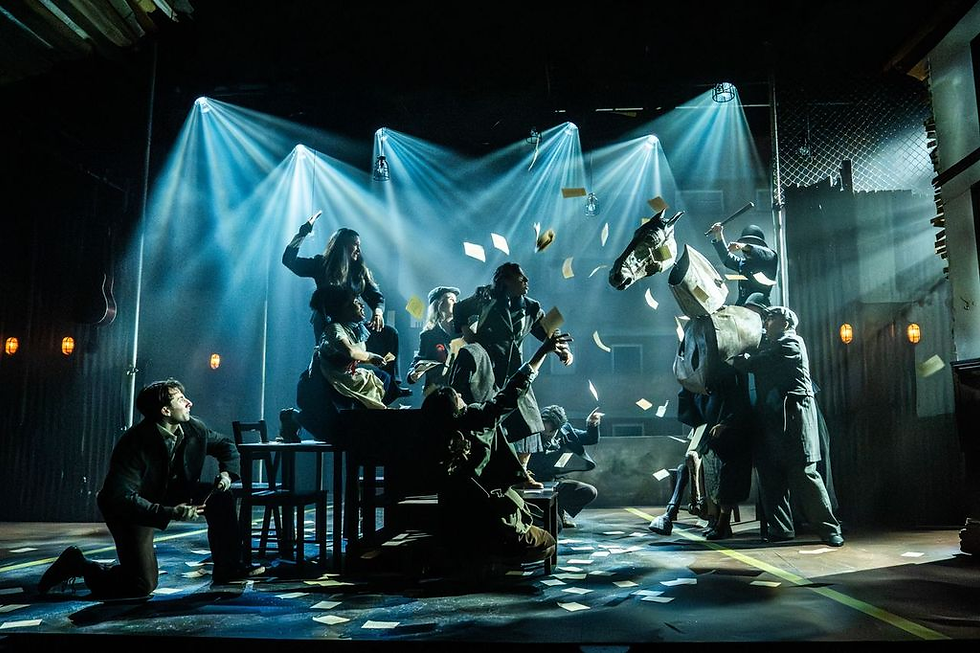
Vocally, the cast is undoubtedly one of the production’s greatest strengths. Solo numbers consistently showcase the performers’ abilities, but the most effective moments arise when voices unite in harmony. These ensemble sections musically embody the show’s central message — that collective strength is far greater than individual struggle.
The production finds renewed momentum in the opening of the second act, as the revolution takes shape. This section features some of the show’s most visually and emotionally compelling moments, including inventive lighting (Sam Waddington and Ben Jacobs) and prop design (Helen Foan) — notably transforming simple wooden structures into a convincing horse. The theatrical poetry here is genuinely impressive. However, the latter part of the act begins to drag, introducing scenes that add little to the narrative while overlooking moments that could have been further developed.
Ultimately, Cable Street is an honourable and ambitious attempt to tell an important story. While its execution is occasionally misguided, the strength of its performances, vocal work and moments of theatrical poetry point clearly to its potential. With tighter pacing and further structural refinement, this production could develop into something genuinely powerful — a piece of theatre that not only honours its historical roots but resonates strongly with contemporary audiences. Even in its current form, Cable Street succeeds in reminding us of the importance of unity, and of the enduring impact theatre can have when it dares to confront difficult truths.
Production Value: 60%
Value For Money: 65%
Personal Enjoyment: 65%
Overall Score: 63% - ⭐️⭐️⭐⭐️ (4*)
(AD | gifted in exchange for an honest review)
Show Information
Venue: Marylebone Theatre, London
Playing until: 28th February 2026
Run Time: Approximately 2h35 - including a 20 minute interval
Tickets for this show can be found at this link.


Comments