
Redcliffe - Southwark Playhouse Borough
Making theatre is a labour of love - one that is in equal parts deep, passionate, turbulent and challenging. Nevertheless, despite years of uncertainty and a whole lot of trust, both the creation process and true love itself, are worth every struggle. This sentiment echoes through Redcliffe, a debut musical from Jordan Luke Gage currently playing in the Large at Southwark Playhouse Borough. After three years in development, the musical beams with Gage’s devotion to the previously untold story of love, which outlasts even the most tragic of its consequences.
Notably, Gage, who’s established himself as one of West End’s most sought after performers, is not only the author of Redcliffe’s book, music and lyrics (an enormous feat in itself), but also one of the show’s protagonists. Unquestionably, the multiple creative and performing hats fit Gage exceptionally well.
Inspired by true events in 18th century Bristol, Redcliffe explores the forbidden romance between William Critchard (Jordan Luke Gage), the district’s local, and Richard Arnold (Daniel Krikler), a visiting sailor. Set at a time when falling deeply and passionately for each other was the men’s very ‘sin’, Redcliffe does not shy away from portraying the horrifying ostracism and persecution of the LGBTQ+ community based on socially established guidelines of what ‘real’ love should look like. At the same time, the musical allows space for respite, acceptance, laughter and (lots of) joy.
At its core, this beautiful, heartfelt, yet heart-breaking story, remains painfully relevant three centuries later.

This reviewer’s first perceptual experience of the material, perhaps facilitated by the seat location, was one of relief - in the midst of the London heatwave, it was pleasant to be greeted with a breeze, subtly coming in from the auditorium’s sides. Apart from its cooling nature, the breeze was of course a device indicative of the maritime aspects of the show - both William and Richard arrive in Redcliffe via the sea, which is clearly communicated in the first scene by the soundscape, the physical embodiment of movement by performers on the ship (choreography by Emma Woods) and Phoebe Kyriakopoulos's melodic voice, resembling one of a siren, which gracefully opens the show.
Jordan Luke Gage’s William is shy, hard-working and loyal - a good son with one ‘flaw’ (according to his Mother, so expertly played by Rebecca Lock) - he has yet to find a girl to love and be loved by. Therefore, it is with pleasure and joy to watch how Gage’s delicate, endearing and somewhat lost William grows to find himself and be found upon meeting Daniel Krikler’s Richard - seemingly more-experienced in terms of romantic relationships (and world knowledge, as he attempts to make clear in ‘A Million Things I Know’). Krikler complements Gage’s youthful enchantment with a confident façade, which softens as the pair acknowledge the feelings towards each other.
The ensemble cast is incredibly strong throughout, with Steven Serlin seamlessly transitioning from a stern and deeply unlikeable officer, to a cheerful, yet rooted deeply in homophobia town-favourite Felix Farley. Rebecca Lock as Mother and Jess Douglas-Welsh as Abigail, William’s younger sister, give standout performances. The mother-daughter duo present impeccable family dynamics, getting excited about their ideal of a wedding, followed by desperately looking for a loophole to bring William back home. Lock brings fantastic comedic timing and eccentricity to the role, perfectly embodying the humour of Gage’s writing (as evidenced by the audience’s enthusiastic reaction and laughter), while equally convincingly portraying a mother’s heartbreak and grief in response to the events of the second act. Douglas-Welsh, having been previously attached to Redcliffe’s workshops, brilliantly makes her London debut as an understanding sister, who is on a journey of love and self-discovery herself. Abigail’s youthful relationship with Arthur (Joseph Peacock), an aspiring baker for whom age 15 is ‘time to get serious’, is perceived as the ‘right’ way to love and provides a contrast to her brother’s love story. Yet, it doesn’t diminish Abigail’s depth of acceptance and love towards William, as well as discovery of her own ambitious aspirations that Douglas-Welsh truthfully conveys. The ensemble cast, often quietly present on stage, reminds the audience of the constant supervision, quick judgment and invasive interference of the townsfolk in the private lives of others.
The costumes by Martin Hanly nod to the tradition of the period, with a modern twist. A commendable mention, most likely the result of a collaboration between Hanly, Emma Woods (choreography) and Paul Foster (direction), is Abigail’s dream sequence. Pieces of sheer fabric in a variety of shades of purple are interwoven around the young girl in a series of ensemble movements, creating a beautiful dress which Abigail dreams about sewing and wearing to a dance. The purple provides a nice contrast to the otherwise earthy colour palette of the show, symbolising joy and hope. It also, perhaps, suggests Abigail’s desire to impress the more affluent Arthur by wearing the colour associated with luxury.
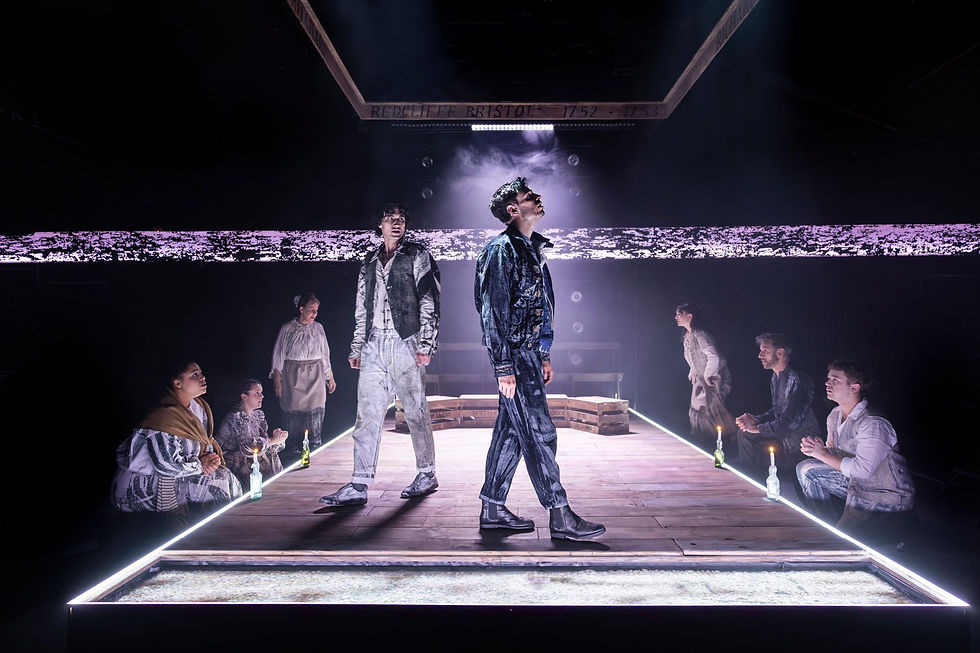
Foster’s direction offers quick transitions from scene to scene, supported by clever use of props and set (Andrew Exeter). The choice to have a pool of water at the front of the stage acts as a link between domestic chores and activities (washing of clothes), with religious behaviours (holy water), and a medium which ‘swallows’ an execution device - a means of foreshadowing we are so painfully reminded of at the show’s conclusion. The wooden frame above the stage, inscribed with William Critchard, Richard Arnold, as well as the place and date of events, is a looming presence reminding us of the truth (partial at least) of the story and honouring the many lives that have been lost throughout centuries for wishing to love freely. Such a tribute is also expressed at the end of the show by the actors stepping out of character and delivering more factual information about the story’s background (resembling the post-show moment at ‘A Christmas Carol’ at the Old Vic). However, as beautiful and important as the moment was, the transition felt somehow disjointed and would perhaps benefit from a refinement to further emphasise the meaningful sentiment.
Gage’s musical skill comes across in the music of Redcliffe, which presents a variety and ‘plethora’ (word that none of the audience members will forget) of ballads and up-beat songs, supported by Ben Tomalin’s musical direction and orchestrations. Despite several of the song lyrics being somewhat conventional and predictable, the lyricism and storytelling soon finds its most exciting and powerful, immersing the audience fully.
Interestingly, with Redcliffe quickly gaining audience appreciation and engagement, it also offers post-show events about the show’s creation several times during its run, with a special Q&A exploring Queer stories on Thursday 2nd July (post-evening show).
All in all, Gage makes a commendable musical theatre creative debut with this vital production, enhanced by a fantastic cast. By bringing awareness to issues directly impacting hundreds of thousands of lives around the world and highlighting the power of being able to love freely, openly and unapologetically, Gage establishes himself as a Creative to watch.
Production Value: 80%
Value for Money: 80%
Personal Enjoyment: 80%
Overall Score: 80% - ⭐️⭐️⭐️⭐️ (4*)
(AD | Ticket gifted in exchange for an honest review)
Show Information
Venue: Southwark Playhouse Borough, London, United Kingdom
Playing until: 4th July 2026
Run Time: 2h 30min - including an interval
Tickets for this venue can be booked at the link here.
Comments